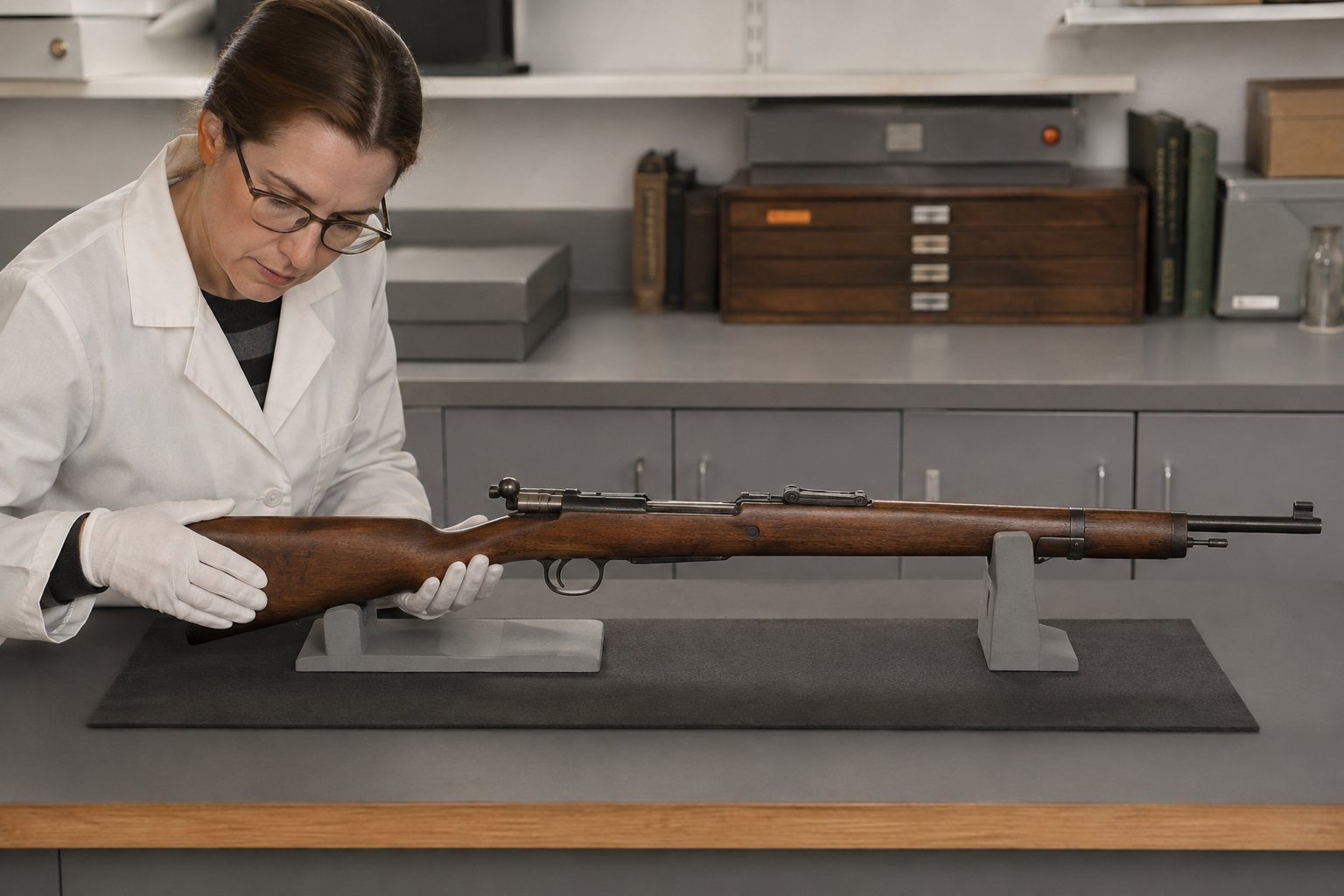
Record a military firearm as found, before cleaning, disassembly or cosmetic work. Confirm that it is unloaded, keep the muzzle pointed safely, and photograph serial numbers, stamps, proof marks, repairs and unusual finishes. These details may preserve more evidence of service life than a polished surface.
The central principle in a sound evaluation is intended service context. A rifle, pistol or machine gun was designed for a particular military problem, supply system and period. Understanding that setting helps distinguish original features from later changes and prevents collectors from judging historical firearms by modern expectations.
Start With the Role It Was Built to Fill
A long infantry rifle, compact service carbine and sidearm may share national markings while serving different purposes. Their proportions, controls, sights and finishes reflect those assignments. A feature that seems crude or inconvenient may have suited mass issue, field maintenance or contemporary equipment.
Begin with role rather than appearance. Ask what the military expected the arm to do, who would carry it and what conditions shaped its design. A Mauser-pattern service rifle, an M1 Garand and a Lee-Enfield can all be military arms, but their handling and historical meaning cannot be judged by one standard. If a feature seems unusual, first ask whether it supports the original role before calling it damage, alteration or a manufacturing variation.
Read Markings as a Chain of Custody
Markings can connect an object to a manufacturer, military authority, inspection process, arsenal or later user, but their meaning depends on location and context. A matching serial number may support a coherent history; a mismatch does not automatically make an arm uninteresting, but it limits what can responsibly be claimed.
Consider the evidence together. Record receiver or frame marks, barrel stamps, acceptance symbols, property marks, import marks and arsenal repairs separately. Spelling, font, depth, placement and signs of removed or restamped marks may matter. Photograph them clearly, since memory is unreliable when several marks are close together. Do not turn one stamp into a complete story. Distinguish what is visible from what is inferred, especially when reference works or specialists disagree.
Treat Modifications as Historical Evidence
A changed stock, replacement barrel, repaired handguard or updated sight may document service use rather than merely reduce originality. Military organizations routinely kept arms useful through repair, refurbishment and standardization. The same model may appear in an early configuration, a later arsenal form or a mixture of parts assembled during service.
Ask not only, "Is it original?" but also, "Original to which stage?" A component may be correct for the model but wrong for its production period. It may instead be a period repair with historical value, even if it was not factory-installed. A sound replacement, documented arsenal change and undocumented modern substitution represent different conditions.
Separate Wear From Neglect
Wear becomes meaningful when its location, pattern and surrounding condition are considered. Finish loss on contact points may reflect handling, storage or issue use. A damaged screw slot, battered edge or uneven surface may suggest repeated servicing. Corrosion in a critical area, a cracked component or an unknown alteration demands caution rather than interpretation.
A safe evaluation does not require proving a firearm's history by operating it. If its condition, loading status or mechanical state is uncertain, stop and refer it to a qualified gunsmith or other competent professional. Do not test an unfamiliar arm with ammunition or assume that an apparently empty firearm is safe without appropriate handling procedures.
Clean cautiously. Aggressive polishing, abrasive compounds or removal of aged finish can erase markings and surface evidence. Preservation is not the same as making an object look new.
Use Provenance Without Letting It Lead the Evidence
Provenance is the documented path connecting an object to previous ownership, issue, recovery or transfer. Strong provenance can explain an unusual marking or configuration, but an attractive story does not replace physical evidence. Classify claims as documented, consistent with the object, plausible but unverified or unsupported.
Useful records may include dated photographs, receipts, service paperwork, family documents, auction descriptions and correspondence from recognized archives or specialists. Preserve original wording where possible and identify who made each claim. A note that a rifle "was carried overseas" is not equivalent to a service record naming the person, unit and period.
For a disciplined evaluation:
– Photograph every marking before cleaning or disassembly.
– Record each mark's location and exact wording.
– Note mismatched parts, repairs, finish changes and visible damage.
– Separate documented facts from interpretation.
– Preserve supporting papers with the firearm's records.
– Have uncertain safety or mechanical issues assessed professionally.
Compare Systems Through Their Constraints
The most useful comparisons connect systems through shared historical constraints. Supply pressure, training demands, manufacturing capacity, ammunition standardization and battlefield mobility shaped choices across nations and periods. A stamped component on one arm and a simplified finish on another may both reflect an institution trying to keep large numbers of weapons serviceable.
A recognizable model is not self-explanatory. The same pattern may have been produced for different contracts, rebuilt by different authorities or altered for later service. A model name identifies a starting point, not a complete biography. Before concluding, ask whether the physical evidence, markings and claimed history point in the same direction. If they do not, describe the disagreement plainly. Uncertainty is not a defect in the record; hiding it is.
Keep Safety and Rules Separate From Historical Judgment
Historical interest never changes safe-handling requirements. Treat every firearm as loaded until its condition has been established through appropriate procedures, keep ammunition away during examination and avoid manipulating controls or disassembling unfamiliar designs. Children and unauthorized users should not have access.
Ownership, transport, storage, transfer and deactivation rules vary by jurisdiction and can change. Consult current official guidance and, when necessary, a qualified local professional before moving or transferring a firearm. Legal status is separate from age, rarity or historical importance.
The strongest evaluation is modest in its claims and precise in its evidence. Context does not make a questionable object certain, but it reveals which details deserve attention and which conclusions should wait.